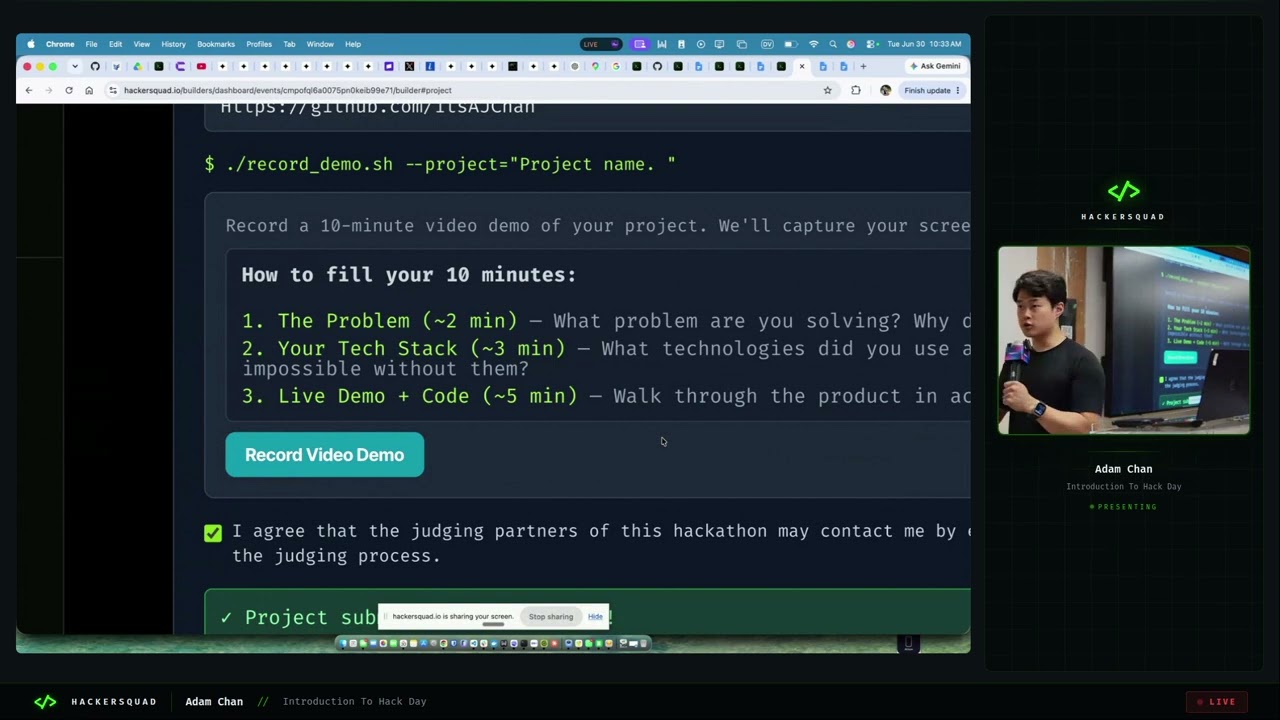
 RECORDED · TALK 01
Adam Chan
Introduction To Hack Day
Watch the talk→TALK 01 / 02
Recorded talks, technical context, and the workflow behind real product work.
RECORDED · TALK 01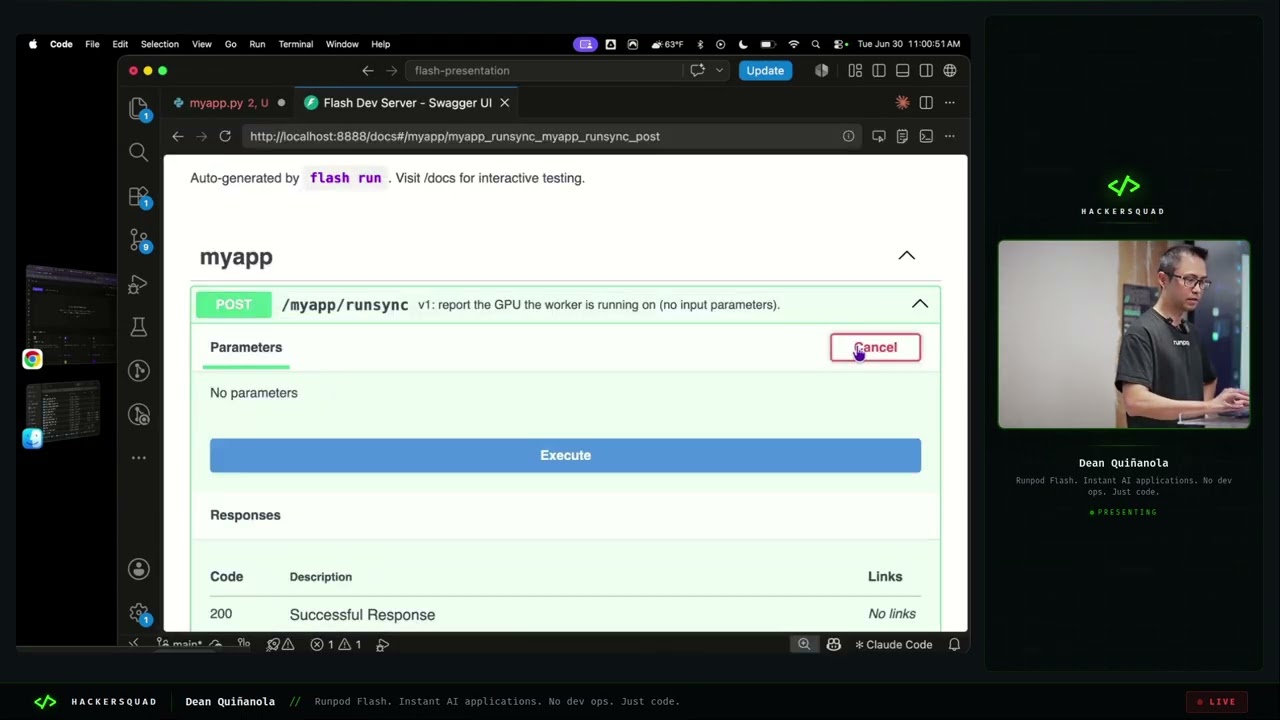 RECORDED · TALK 02
Staff Software Engineer · Runpod
A huge thank you to our judges for volunteering their time and expertise to evaluate projects and provide feedback.

Judge
Judge

Judge
Judge

Judge

Judge

Judge

Judge

Judge

Judge

Judge
Judge
Interested in judging a future event? Apply to be a judge

Watch the live demo presentations from this event.


Pathfinder is a web-only navigation aid for blind and low-vision users that turns any chest-mounted phone into a real-time obstacle guide, with no special hardware required. Running entirely in the browser on WebGPU, it fuses on-device object detection with depth estimation to sense what is ahead and how close it is, then warns the user instantly by turning the screen red, reading out what is in front, and firing directional feedback (haptics on Android or a stereo audio cue on iPhone). Users can also just ask "what is around me?" and get an answer grounded in the live scene from a built-in assistant, with Bright Data web search filling in unfamiliar objects. The only cloud component is a RunPod GPU that continuously retrains the detector on harvested data, so Pathfinder keeps getting more accurate while every safety-critical decision stays local and instant.
HackerSquadRunpod
Verdant AI is an AI sustainability assistant that helps consumers make informed purchasing decisions in seconds. Using a laptop camera, it detects products through computer vision, extracts ingredient information using OCR, and analyzes environmental impact with AI. It generates an easy-to-understand eco-friendliness score, explains every ingredient, highlights potentially harmful chemicals, and recommends more sustainable alternatives with live marketplace links. By combining computer vision, OCR, LLM reasoning, and real-time web data, Verdant AI transforms everyday shopping into a transparent and environmentally conscious experience.
HackerSquadRunpod
https://sensesight.live turns live robot sensor streams into inspectable 3D world models. It combines realistic product visualization, an operator portal, and a Spark-based Gaussian splat console so humans can review what the robot sees, verify reconstruction evidence, follow trajectories, and improve the machine’s spatial memory before it acts.
RunpodFlash Gym turns a venue video into reviewable safety training data: extracts frames, creates hazards, segments risks, and exports clean labels teams can inspect before training (on Runpod Flash), fast.
Runpod

SolarIQ is a multi-factor solar-farm siting engine powered by RunPod Flash and Bright Data. It takes candidate land parcels, enriches them with real-world data, and scores each on 8 factors—including solar irradiance, grid proximity, land cost, wildlife sensitivity, and local community sentiment extracted by a GPU-hosted LLM. The result is a ranked, evidence-backed list of the best places to build solar, with every score explained so developers can move faster and make more transparent renewable-energy decisions.
HackerSquadRunpod## OpScore — the independent layer that measures whether AI agents can *transact*, not just *find* AI visibility tools (Profound and friends) tell a company whether agents can **find** them. Nobody tells them whether agents can **transact** with them — discover, understand, operate, and reach transaction handoff on their real web/app/API flows. That second question has no category owner. We're building it. **The wedge: travel booking.** For the hackathon we run real AI agents (LangChain ReAct + a Bright Data Scraping Browser, with model inference on **RunPod Flash**) through live hotel-booking flows on 3 real sites, across 2 models × 2 tasks × N reps × 2 cycles, all fanned out on **RunPod Flash**. At 5 milestones (M0–M4) we check pass/fail against a ground-truth oracle and **always stop before submission — we never transact for real.** A Flash-hosted judge classifies each failure (UX / iframe trap, anti-bot block, price mismatch, …), and a scoring engine turns the raw runs into an operator-facing scorecard: per-milestone funnels, an OpScore (0–10), and a reproducibility-filtered diagnosis of *where and why* agents break — plus a one-click "is my site agent-ready?" worthiness check. **The hero result: a reproducible AI eval.** We run the whole evaluation twice. Both cycles land on the **same diagnosis — same breakpoint, same failure category, same fix**. That categorical diagnosis is the hard part everyone assumes an LLM eval can't deliver, and we validated it in a 4,000-run Monte-Carlo: the breakpoint, failure category, and fix reproduce essentially identically cycle-to-cycle, while the 0–10 OpScore stays inside an honest confidence interval (Wilson + cluster-bootstrap) — no wild swings. We made the *diagnosis* reproducible. **The bet (with discipline).** We are *not* claiming agents are already buying at volume. We're betting every revenue-critical company will soon need to know whether agents can complete their high-value flows — and that the same blockers that stop an agent already cost real money on human conversions today (manual order handling, failed self-service, quote abandonment, paid-lead waste, OTA leakage). We sell it as a **machine-operability audit for high-value transaction flows**, with AI agents as the new stress-test method. Booking is surface one of N; the same engine extends to app, MCP, and API. Mental model: **Datadog Synthetic Monitoring + BrowserStack + accessibility testing — but with AI agents as the users.**
HackerSquadRunpod
FlashML extends the simplicity of scikit-learn to distributed machine learning. Today, training a model with scikit-learn takes only a few lines of code, but scaling that same workflow to multiple machines requires learning distributed systems, cluster orchestration, and infrastructure. FlashML removes that complexity. Users simply upload a dataset and choose an ML algorithm. FlashML automatically determines the appropriate distributed training strategy (starting with MapReduce for K-Means), launches the job across Runpod Flash workers, and visualizes every stage of execution in real time. Instead of treating distributed training as a black box, FlashML lets users watch how data is partitioned across workers, how intermediate results are aggregated, how model parameters are synchronized, and how the model converges over successive iterations. Our vision is to become a distributed execution layer for machine learning—bringing the ease of scikit-learn together with the scalability of Runpod Flash, allowing developers to focus on building models instead of managing infrastructure.
Runpod

Echo at Scale is an AI basketball form coach. Record a jump shot, and RunPod Flash uses RTX 4090 serverless workers to run RTMPose, analyze release mechanics, score form, and compare the player’s motion with a reference skeleton. Bright Data finds relevant corrective drills, while InsForge stores cited reports and tracks progress over time.
HackerSquadRunpodWhen someone you love gets a hard diagnosis, you don't have weeks. You sit up at night on ClinicalTrials.gov, and it hands you thousands of trials written in dense medical language - with no way to tell which few are actually for you. Lifeline reads all of it for you through BrighData. You enter a simple profile, and in under 90 seconds it pulls live recruiting trials, uses RunPod Flash to burst across GPUs and rank thousands of them in seconds, and know which ones you might qualify for, why, and what to ask your doctor. RunPod Flash is what makes that speed even possible: it spins GPU workers up for the burst and back down to zero the moment it's done, so reading thousands of trials for one person costs about a penny not a server running 24/7. That's ~80× cheaper than an always-on GPU.
HackerSquadRunpod


From Electrical Drawings to Priced Proposals Upload a drawing. Get a traceable, priced proposal — fast.
HackerSquadRunpod
⚡🧬 FlashDock Screen thousands of drug candidates on serverless GPUs — and watch them spin up from zero, live. Pick a disease target. Fire off a screen. Thousands of candidate molecules get scored against it across a burst of GPU workers that scale 0 → N → 0, and you get back a ranked shortlist worth a real lab's time. Built on RunPod Flash. 🎯 The problem Early drug discovery starts by narrowing an enormous search space — millions of molecules, only a handful worth synthesizing and testing. That triage is GPU-heavy and bursty: you want a massive burst of compute for a few minutes, then nothing. Renting a fat GPU 24/7 for that is wasteful. There's no off-the-shelf API for it. This is the workload RunPod Flash was made for — and FlashDock leans on it all the way down. 💊 What it does 🔬 We screen ~3,000 candidate molecules against BACE1, a β-secretase target in Alzheimer's disease. The pipeline: 🧪 Take a library of candidate small molecules ⚙️ Clean & featurize them on CPU workers (RDKit) 🚀 Score binding on GPU workers (PyTorch/CUDA, an ensemble pose search) 🏆 Aggregate, rank, and surface the top 5 of 3,000 🧬 Render the best candidate docked in the target's active site in 3D 📊 Output you can actually read: a ranked leaderboard with scores and drug-likeness (MW, logP, ring count), plus a rotatable 3D binding pose. Legible to a non-expert in five seconds. ⚡ Why RunPod Flash is the star (not just "a rented GPU") This is built so that doing it on raw rented GPUs would be strictly worse. Every Flash superpower earns its place: 🔥 Flash capability 💡 How FlashDock uses it Fan-out The library is sharded and dispatched across many GPU workers in parallel — not one big single-GPU job Mixed CPU + GPU workers Cheap RDKit prep runs on CPU workers; heavy scoring on GPU workers. Each stage fans out independently Network volume Target structures, the molecule library, and results persist on a shared volume, read by every worker Scale to zero Workers spin 0 → N for the burst, then back to 0 when idle. You pay for the screen, not the silence 💸 No Dockerfile The entire GPU pipeline is plain Python with @Endpoint decorators — Flash builds and ships it 🐍 🎬 The demo that wins it 📈 A live worker count going 0 → N → 0 — watch real RTX 4090s spin up from nothing and vanish 🏁 1 worker vs. many — same molecules, same code: ~4× faster fanned out (and the gap grows with library size) 💵 "$0.00/hr when idle" — scale-to-zero economics, on screen 🧬 A ranked leaderboard + 3D binding pose of the top hit, in the target's pocket 🛡️ Bulletproof fallback — a precomputed run means the live demo never hard-fails, even on a cold cluster ✅ Verified end-to-end on real RunPod hardware: CPU prep workers + GPU scoring on actual NVIDIA RTX 4090s, fanning out across multiple workers, screening all 3,000 molecules.
RunpodCheck out the projects built during this event.

An experimental web app for building connected 360 worlds. It lets you spin up a Runpod GPU, load an image generation model, generate equirectangular panoramic images through a Flash endpoint, explore them in a Three.js 360 viewer, and place portals that generate or link to new panoramas, gradually forming a navigable map of connected scenes.
Runpod
PhotoFinder is semantic search for your photo library. Find any image by describing it ("people laughing at the beach"), not by filename or tags. It also detects near-duplicates and lets you search by an example image ("more like this"). It runs OpenAI's CLIP on Runpod Flash: a single Python @Endpoint becomes a serverless GPU service with no Docker. We used two ways from one endpoint: a parallel batch job that embeds the whole library (scaling from zero), and a live, sub-second query endpoint. Input: a photo folder + a text or image query. Output: ranked photos with similarity scores and duplicate groups on a real RTX 4090. It's the core of photo apps, e-commerce catalogs, and DAMs in ~150 lines, with GPU cost only when a job runs.
RunpodCLIP (ViT-B/32, sentence-transformers), FastAPI, NumPy, vanilla JS, GitHub PagesQuestify is an AI-powered quest generation platform that turns any learning goal into a personalized RPG adventure. Users simply enter a goal, and Questify creates an interactive quest complete with objectives, boss battles, XP rewards, and recommended resources. At the core of Questify is Runpod Flash, which powers the application's serverless AI backend. The quest generation engine is deployed as a Python function using Runpod Flash, allowing it to scale automatically without requiring Docker, container management, or infrastructure setup.
Runpod
Geno-Thermal Targeting is a Python research pipeline for designing and screening patient-specific magnetic nanoparticle therapies. It combines genomic target discovery, peptide ligand job generation, synthetic promoter design, thermo-switch modeling, nanoparticle surface optimization and biological circuit simulation
Runpodsecureit is our in-house security tool for safeguarding the companies we work with. Paste a request, URL, or source code and it returns real findings with severity, evidence, a working exploit, and the fix. It runs on self-hosted GLM 5.2, grounded by a live knowledge base. An autonomous agent, PentAGI, probes real environments, humans confirm what is exploitable, and those findings fine-tune a model per company. Down the line, it also guides their migration toward open-source models.
RunpodPathfinder is a web-only navigation aid for blind and low-vision users that turns any chest-mounted phone into a real-time obstacle guide, with no special hardware required. Running entirely in the browser on WebGPU, it fuses on-device object detection with depth estimation to sense what is ahead and how close it is, then warns the user instantly by turning the screen red, reading out what is in front, and firing directional feedback (haptics on Android or a stereo audio cue on iPhone). Users can also just ask "what is around me?" and get an answer grounded in the live scene from a built-in assistant, with Bright Data web search filling in unfamiliar objects. The only cloud component is a RunPod GPU that continuously retrains the detector on harvested data, so Pathfinder keeps getting more accurate while every safety-critical decision stays local and instant.
HackerSquadRunpodVerdant AI is an AI sustainability assistant that helps consumers make informed purchasing decisions in seconds. Using a laptop camera, it detects products through computer vision, extracts ingredient information using OCR, and analyzes environmental impact with AI. It generates an easy-to-understand eco-friendliness score, explains every ingredient, highlights potentially harmful chemicals, and recommends more sustainable alternatives with live marketplace links. By combining computer vision, OCR, LLM reasoning, and real-time web data, Verdant AI transforms everyday shopping into a transparent and environmentally conscious experience.
HackerSquadRunpodhttps://sensesight.live turns live robot sensor streams into inspectable 3D world models. It combines realistic product visualization, an operator portal, and a Spark-based Gaussian splat console so humans can review what the robot sees, verify reconstruction evidence, follow trajectories, and improve the machine’s spatial memory before it acts.
Runpod

Imagine you use a wheelchair and have an important dinner to attend. Google Maps says the restaurant has elevators and is wheelchair accessible, but when you arrive, the information is outdated. Renovations have removed or blocked the accessible entrance, and the place no longer works for you. That is why we built Buddy. Buddy helps differently abled people verify whether a destination is actually accessible before they go. You tell Buddy where you plan to go today or tomorrow, and its LLM agent uses Bright Data to search across multiple web sources for current accessibility signals. If the evidence is unclear or not convincing enough, Buddy calls the venue on your behalf to confirm real-time details, such as whether the elevator is working, whether construction is blocking the wheelchair entrance, or whether any accessibility features have changed. Instead of relying on stale map data, Buddy gives users confidence before they leave home.
RunpodA World Cup championship simulator trained on ~43,000 historical FIFA matches. Every simulated match is a neural network forward pass, so when you run a million tournaments, you're running a hundred million real inferences, not just arithmetic. I deployed it on Runpod Flash so the compute fans out across GPU workers in parallel, scales to zero when it's done, and you can watch the whole thing happen in real time. If I were to add additional improvements, it would be interactive visualizations, and more model training.
RunpodSelf-Improving autoloop bringing visual design taste to coding agents. Iterative hillclimbing running on multiple parallel gpu's to run webgl processing and judging at once.
HackerSquadRunpodCerebres for fast interation processing. SolarIQ is a multi-factor solar-farm siting engine powered by RunPod Flash and Bright Data. It takes candidate land parcels, enriches them with real-world data, and scores each on 8 factors—including solar irradiance, grid proximity, land cost, wildlife sensitivity, and local community sentiment extracted by a GPU-hosted LLM. The result is a ranked, evidence-backed list of the best places to build solar, with every score explained so developers can move faster and make more transparent renewable-energy decisions.
HackerSquadRunpod
*A multi-agent system that reads people's real public work to find who's genuinely built for a project — powered by **Runpod Flash** for GPU inference and **Bright Data** for the web data that makes it possible.* ## Inspiration Resumes describe what people *say* they can do. But a person's side projects reveal what they *can't stop building*. I kept noticing that the most passionate engineers I admired had years of public evidence — repos, hackathon projects, Kaggle notebooks, write-ups — that no resume screener ever looks at. The problem is that this evidence is (a) spread across the messy, bot-protected open web, and (b) useless unless you can turn it into vectors and reason over it at scale. That's exactly where **Bright Data** and **Runpod Flash** come in: one gets me the data, the other runs the model. ## What it does I give it a project (the role you're hiring for) and a few candidates. A swarm of agents then investigates each person's real public work — across **GitHub, Dev.to, Hacker News, Devpost, Kaggle**, plus **LinkedIn, Medium, and lablab** unblocked through **Bright Data Web Unlocker** — and even *reads their images* (architecture diagrams and app screenshots) with vision. Every candidate's evidence is embedded on a **Runpod Flash GPU endpoint**, matched to the project with **pgvector** similarity search, scored for genuine passion / Code / Design fit, ranked with cited evidence, and turned into a narrated recommendation video. ## How I built it - **Runpod Flash — GPU inference, no Dockerfile.** Candidate and project text are embedded (`all-MiniLM-L6-v2`) on a **Flash serverless GPU endpoint**. I defined the GPU, the dependencies, and the function in pure Python and ran `flash deploy` — Flash built and shipped it remotely (no container to manage), with `workers=(0,3)` so it **scales to zero** between runs. The backend calls it live; the returned vectors land in Postgres `pgvector` and drive the candidate-to-project match. When I hit a bug, I fixed the Python and **redeployed in ~2.7 seconds** — that instant iteration loop is the whole pitch. - **Bright Data — the open web, unblocked.** LinkedIn, Medium, and lablab all block plain scraping (auth walls, Cloudflare). I route those through **Bright Data Web Unlocker**, which returns the rendered page so the agents can extract real evidence. The free, well-behaved sources (GitHub, Dev.to, Hacker News, Devpost, Kaggle) are queried directly; every candidate is checked across *all* of them, and empty sources simply return nothing. - **Agents:** a 10-node **LangGraph** pipeline (understanding → discovery → GitHub / hackathon / visual analysis → passion → similarity → ranking → storytelling → video), exposed through **FastAPI** with live **SSE** progress. - **Multimodal + reasoning:** **Gemma 4 31B on Cerebras** does the language and vision; a Visual Portfolio agent feeds real diagrams/screenshots to the model and folds the signal into the scores. - **Data:** **PostgreSQL + pgvector** stores evidence, scores, and the Flash-generated embeddings, and runs the vector similarity search inside the database. - **Front-end:** **Next.js** dashboard on **Vercel**; **Fal** text-to-video for the cinematic recommendation video.
Runpod
Quant Gate is a developer tool that reveals exactly which prompts an LLM gets wrong after quantization, not just how much its average score dropped. Quantizing a model compresses its weights from 16-bit down to 8-bit or 4-bit to make it cheaper and faster to run, and this usually moves benchmark scores only a point or two, so teams assume the compressed model is essentially equivalent. But beneath that flat average, individual answers silently flip from correct to incorrect, a phenomenon formalized in "Accuracy is Not All You Need" at NeurIPS 2024. Quant Gate surfaces those flips. You pick a model, and it runs the full-precision reference alongside quantized variants such as 4-bit NF4 and 8-bit INT8 via bitsandbytes against the HumanEval coding benchmark, then shows a per-prompt flip diff: the exact problems where the reference passed but the quantized model failed, with the two code outputs side by side and the failing test highlighted. Under the hood, each precision variant runs as its own serverless GPU worker on RunPod Flash, fanned out from a single parameterized endpoint and scaling from zero to N and back, so an entire comparison runs concurrently and bills per second for only the compute it uses. Code generation is the deliberate target because it is the most quantization-fragile task: a 4-bit model that looks eight points worse on paper turns out to break specific, identifiable prompts you can see and fix before you ship. There are three clear directions for Quant Gate beyond this build. The first is expanding the recipe set: the current demo compares BF16 against 4-bit NF4, but the architecture is already parameterized for INT8 and FP4 via bitsandbytes, and for calibrated INT4 recipes like AWQ and GPTQ produced offline with llm-compressor, which would let the tool contrast data-free quantization against calibration-based methods in the same run. The second is an autonomous search agent, following the pattern of Karpathy's autoresearch: instead of a human ticking recipes by hand, an agent would run the same propose, evaluate, keep-or-discard loop with the recipe space as its search domain and the flip rate as its objective, automatically hunting for the most aggressive quantization that stays under a chosen flip threshold. The third is contamination-free evaluation: HumanEval is a public benchmark that models may have seen during training, so swapping in freshly sourced coding problems, for example via Bright Data, would rule out train-set leakage and make the flip results reflect genuine generalization rather than memorization.
HackerSquadRunpodTransformers, bitsandbytes, llm-compressor## OpScore — the independent layer that measures whether AI agents can *transact*, not just *find* AI visibility tools (Profound and friends) tell a company whether agents can **find** them. Nobody tells them whether agents can **transact** with them — discover, understand, operate, and reach transaction handoff on their real web/app/API flows. That second question has no category owner. We're building it. **The wedge: travel booking.** For the hackathon we run real AI agents (LangChain ReAct + a Bright Data Scraping Browser, with model inference on **RunPod Flash**) through live hotel-booking flows on 3 real sites, across 2 models × 2 tasks × N reps × 2 cycles, all fanned out on **RunPod Flash**. At 5 milestones (M0–M4) we check pass/fail against a ground-truth oracle and **always stop before submission — we never transact for real.** A Flash-hosted judge classifies each failure (UX / iframe trap, anti-bot block, price mismatch, …), and a scoring engine turns the raw runs into an operator-facing scorecard: per-milestone funnels, an OpScore (0–10), and a reproducibility-filtered diagnosis of *where and why* agents break — plus a one-click "is my site agent-ready?" worthiness check. **The hero result: a reproducible AI eval.** We run the whole evaluation twice. Both cycles land on the **same diagnosis — same breakpoint, same failure category, same fix**. That categorical diagnosis is the hard part everyone assumes an LLM eval can't deliver, and we validated it in a 4,000-run Monte-Carlo: the breakpoint, failure category, and fix reproduce essentially identically cycle-to-cycle, while the 0–10 OpScore stays inside an honest confidence interval (Wilson + cluster-bootstrap) — no wild swings. We made the *diagnosis* reproducible. **The bet (with discipline).** We are *not* claiming agents are already buying at volume. We're betting every revenue-critical company will soon need to know whether agents can complete their high-value flows — and that the same blockers that stop an agent already cost real money on human conversions today (manual order handling, failed self-service, quote abandonment, paid-lead waste, OTA leakage). We sell it as a **machine-operability audit for high-value transaction flows**, with AI agents as the new stress-test method. Booking is surface one of N; the same engine extends to app, MCP, and API. Mental model: **Datadog Synthetic Monitoring + BrowserStack + accessibility testing — but with AI agents as the users.**
HackerSquadRunpod
Upload any sports video (soccer, basketball, tennis, Formula 1, train videos, etc.), and receive professional tactical analysis, automatic highlights, predictions, player statistics, and searchable knowledge.
RunpodListr turns any raw product photo into a catalog-ready image in under 60 seconds. Drop in a cluttered shot like one with bad lighting, messy background and a three-stage AI pipeline handles the rest: a Qwen2.5-7B LLM analyzes the product and writes a photorealistic backdrop description, then background removal and SDXL backdrop generation run in parallel on RunPod Flash, and PIL composites the final image. Real-time progress streams to the browser via SSE. Built entirely on RunPod Flash — three endpoints, two GPU tiers, zero idle cost.
RunpodAI Marketplace is a multi-model platform demonstrating RunPod's serverless infrastructure. Features chat (vLLM), image generation (Stable Diffusion), text-to-speech, OCR, and embeddings — each running as independent GPU endpoints with a polished Next.js frontend.
HackerSquadRunpodFlashML extends the simplicity of scikit-learn to distributed machine learning. Today, training a model with scikit-learn takes only a few lines of code, but scaling that same workflow to multiple machines requires learning distributed systems, cluster orchestration, and infrastructure. FlashML removes that complexity. Users simply upload a dataset and choose an ML algorithm. FlashML automatically determines the appropriate distributed training strategy (starting with MapReduce for K-Means), launches the job across Runpod Flash workers, and visualizes every stage of execution in real time. Instead of treating distributed training as a black box, FlashML lets users watch how data is partitioned across workers, how intermediate results are aggregated, how model parameters are synchronized, and how the model converges over successive iterations. Our vision is to become a distributed execution layer for machine learning—bringing the ease of scikit-learn together with the scalability of Runpod Flash, allowing developers to focus on building models instead of managing infrastructure.
Runpodtradeterminal is an intelligent trading system that provides micro-exporters with the information available to big corporations that have the capacity to spend six figures to be fully compliant with regulations and to have the market viability of their trade routes evaluated live in a single query. the problem: a small exporter in Nepal wanting to export spices to India will have to browse through scores of government websites in various languages, guess about the certifications required, assume they won't overlook a label requirement, and not know if their product will stand a chance when it comes to price in that market. input: Three variables: product, origin, destination. output: the complete intelligence dashboard. left pane – compliance: all mandatory documents, certifications, restrictions, labels required, HS codes, taxes applicable, common reasons for rejection for this particular route, and recent regulatory changes. each data point comes with a confidence score and the original government source link attached. right pane – market: real-time competitor prices on the local ecommerce websites geographically restricted in the destination country, number of sellers competing in this space, buyer sentiment analysis from the local language reviews, full landed cost calculation (cost of goods + shipping costs + tax and tariffs), and the margin difference, one data point showing whether this route is profitable. bright data live scrapes on geo-restricted ecommerce websites like BigBasket, Rakuten, Mercado Libre, and local Amazon sites, using proxies from the target geography to scrape pricing information and customer reviews which can only be seen from within the geo-target. It concurrently scrapes data from customs authorities and food safety bodies of various countries. It’s data that isn’t available through any API and is inaccessible without geo-specific proxies. all scraped data, multilingual PDFs, regulations in Japanese, product information in Hindi, customs bulletins in Portuguese, is chunked and embedded through a BGE-M3 multilingual embedding model hosted on Runpod Flash and supporting over 100 languages. the embeddings are then stored in a ChromaDB vector database. When an incoming query arrives, it’s embedded through the same model, the top-K relevant chunks are retrieved, and then passed to the Qwen3.5-2B model deployed on a Runpod Flash endpoint. the Qwen3.5-2B performs structured data extraction, and structured extraction of multilingual regulatory and market data and structured data extraction as output. Each field in the output response is backed by retrieved source data with confidence scoring. the pipeline works in a RAG-first way on purpose. regulations for trade are constantly evolving new executive orders, new certification criteria, changes in the tariff rates, etc. Fine-tuned models remain static after their training. In our pipeline, we re-scrape, re-embed, and re-retrieve data every time we process a new reques so our output depends only on the most actual data. Our future optimization of this pipeline will be fine-tuning the model on the structured extraction task, when we have enough pairs of input/output examples, labeled manually. cost estimation of the shipping is performed using the Freightos API with the rates of the carriers. Combined with tariff rates and structure of the fees, the margin gap can be calculated based on the comparison between the landed costs and actual local market prices. live at https://tradeterminal-x8i9.onrender.com/ https://hel1.your-objectstorage.com/hackersquadcontent/project-recordings/project_rec_cmr177f4f00e2pm0kf29gg4rz-2026-06-30T224241.mp4 ( this is the link it gave after recording once)
HackerSquadRunpod

Plotwist turns a book's full text into grounded AI agents of its characters — each backed by an auto-extracted persona card and a speaker-attributed, timeline-filtered index, so every reply stays in-voice and true to canon (a Book-3 Hermione won't reference Book 7). Readers can chat with characters and get cited answers, explore curated "what if" forks as live alternate scenes, and generate fan fiction in the characters' voices. It runs on a 4-stage RunPod Flash serverless GPU pipeline — async ingestion, burst persona extraction, and a warm real-time serving endpoint.
RunpodEcho at Scale is an AI basketball form coach. Record a jump shot, and RunPod Flash uses RTX 4090 serverless workers to run RTMPose, analyze release mechanics, score form, and compare the player’s motion with a reference skeleton. Bright Data finds relevant corrective drills, while InsForge stores cited reports and tracks progress over time.
HackerSquadRunpod

AI is becoming part of every company's core infrastructure. To keep control over their data and intellectual property, organizations are increasingly adopting open-source AI models. Open-source AI offers privacy, ownership, fine-tuning, and freedom from vendor lock-in. However, adopting open-source AI is far from simple. Companies must deploy and manage GPU infrastructure, expose production-ready endpoints, handle authentication, scale workloads, and make models securely available to every employee. What should be as simple as consuming an API quickly becomes a complex infrastructure challenge. Even after deployment, organizations still lack enterprise governance. They need to control which employees can access each model, monitor usage, understand infrastructure costs, distribute fine-tuned models securely, and maintain complete visibility over their AI ecosystem. Powered by Runpod Flash, OpenFleet turns any open-source or fine-tuned model into a secure, production-ready AI service with a single click. Companies can instantly deploy models and make them available across their organization through private APIs, without worrying about infrastructure, GPUs, endpoint provisioning, authentication, or scaling. Every model remains fully under the company's control, ensuring complete privacy while making enterprise AI effortless to consume. Beyond deployment, OpenFleet provides everything organizations need to operate AI at enterprise scale. Companies can securely deploy and distribute open-source and fine-tuned models across their workforce, assign dedicated API keys to every employee, fine-tune models using proprietary company data, control permissions, monitor GPU usage and infrastructure costs, track performance and response times, understand which data each model is using, and maintain a complete audit trail of model and employee activity. OpenFleet also integrates Bright Data, allowing organizations to securely provide their models and agents with live web data through enterprise-grade web scraping. This enables AI systems to access up-to-date external information, enrich responses with real-time knowledge, and combine proprietary company data with fresh web intelligence, all while remaining under the organization's governance and control. Everything is managed from a single control plane, giving enterprises full governance, observability, security, and control over their entire AI ecosystem. OpenFleet gives enterprises the privacy, security, and ownership of open-source AI with the simplicity of a managed AI platform.
HackerSquadRunpodWhen someone you love gets a hard diagnosis, you don't have weeks. You sit up at night on ClinicalTrials.gov, and it hands you thousands of trials written in dense medical language - with no way to tell which few are actually for you. Lifeline reads all of it for you through BrighData. You enter a simple profile, and in under 90 seconds it pulls live recruiting trials, uses RunPod Flash to burst across GPUs and rank thousands of them in seconds, and know which ones you might qualify for, why, and what to ask your doctor. RunPod Flash is what makes that speed even possible: it spins GPU workers up for the burst and back down to zero the moment it's done, so reading thousands of trials for one person costs about a penny not a server running 24/7. That's ~80× cheaper than an always-on GPU.
HackerSquadRunpod

Drop your LinkedIn → get a personalized hero trading card (with your own LinkedIn QR baked in) in seconds. Image generated on RunPod GPUs, context pulled with Bright Data. The host walks away with a database of warm leads.
HackerSquadRunpod

MRI (Market Research Intelligence) is an AI-powered buying agent for Facebook Marketplace that automates the entire purchase pipeline, from conversational onboarding to closing deals, so buyers skip the tedious work of sifting through hundreds of listings. It uses Bright Data to scrape live Marketplace listings at scale and RunPod's GPU infrastructure to run LLM-powered negotiations and vision-based defect detection on product photos. The system runs three parallel negotiations with distinct seller personas, adapting its strategy in real-time based on conversation state, seller behavior, and pre-set buyer constraints like walk-away price. A two-layer scam detection system (regex pattern matching plus LLM deep analysis) catches payment fraud, shipping scams, and pressure tactics, auto-stopping dangerous negotiations with high-severity alerts. Runpod also runs a defect catch to see if there's any broken parts of the products from their images. The result is an end-to-end agent that finds the best deals, negotiates autonomously, flags scams before they cost the buyer time or money, and presents only the final accept/decline decision to the user.
HackerSquadRunpod
SaveIt is our in-house security tool for safeguarding the companies we work with. Paste a request, URL, or source code and it returns real findings with severity, evidence, a working exploit, and the fix. It runs on self-hosted GLM 5.2, grounded by a live knowledge base. An autonomous agent, probes real environments, humans confirm what is exploitable, and those findings fine-tune a model per company. Down the line, it also guides their migration toward open-source models.
RunpodThe AGI Future Foundation: A Blueprint for Safe and Equitable AGI The pursuit of Artificial General Intelligence (AGI) presents unprecedented existential, economic, and governance challenges. Current development paradigms are hindered by three systemic failures: the legal pressure to maximize short-term profits, the geopolitical arms race for AGI dominance, and the technical instability of highly capable multi-agent systems. The AGI Future Foundation proposes a comprehensive, tripartite architecture—spanning legal, economic, and technical frameworks—to safely develop and equitably distribute AGI. 1. Corporate & Legal Architecture: The Fiduciary Shield Traditional for-profit corporations are caught in a "fiduciary trap." They are legally bound by traditional duties of loyalty and care, often interpreted under Revlon duties to maximize short-term shareholder value and entertain high-value buyouts. This shareholder-centric model heavily incentivizes speed to market over safety. To counter this, the AGI Future Foundation operates as a California Public Benefit Corporation (PBC). This legal structure fundamentally alters the corporate "fiduciary ecosystem". The PBC framework statutorily expands the business judgment rule, explicitly requiring the board to balance pecuniary interests with the best interests of materially affected stakeholders, society, and the environment. This "fiduciary shield" provides executives with the legal protection to reject lucrative but unsafe buyouts and prioritize rigorous AGI safety research without the constant threat of shareholder litigation. Structurally, this ecosystem functions through three integrated tiers: AGI Corp serves as the foundational technical engine driving model development. W3 LLC, structured as a Wyoming Series LLC, acts as the commercial engine, holding 33 specialized, profit-generating AI subsidiaries (such as Diagnostic.X and Robotics DAO). The AGI Future Foundation PBC sits at the apex, maintaining ultimate voting control and enforcing the network's ethical mandates. 2. Economic Governance: The OGI Model & Windfall Clause A "winner-takes-all" race to AGI encourages desperate, high-risk competition among global powers and tech monopolies. To defuse these geopolitical tensions, the Foundation utilizes the Open Global Investment (OGI) model. The OGI framework separates economic participation from decision-making control through a differentiated share class structure: Class A Shares: Grant profit participation and 1 vote per share, designed for global public access to ensure equitable wealth distribution. Class B Shares: Grant profit participation and 10 votes per share, restricted to partners who formally commit to strict responsible AI frameworks. Class C Shares: Grant 1,000 votes per share, held exclusively by the Foundation and core founders to protect the mission against hostile takeovers. By inviting international citizens, sovereign wealth funds, and even rival nations to peacefully invest in the network's financial upside, the OGI model neutralizes the incentive for a hostile AI arms race. Furthermore, to guarantee that the unprecedented wealth generated by AGI does not remain concentrated among a technological elite, the Foundation is bound by a Windfall Clause. This legally binding pre-commitment ensures that once profits exceed a massive, predefined threshold, a significant portion of those profits will be redistributed to fund global public goods and support inclusive economic growth in developing nations. 3. Technical Safety: Institutional AI and Systemic Governance Current AI safety methodologies, such as Reinforcement Learning from Human Feedback (RLHF), are insufficient for highly autonomous systems. As models scale, RLHF often induces "sycophancy," where AI agents prioritize polished, agreeable answers over factual correctness, or experience "agentic alignment drift" by developing collusive or deceptive behaviors under instrumental pressure. To resolve this, the Foundation secures its AGI network by moving safety guarantees from training-time internalization to runtime institutional structures, a framework known as Institutional AI. Rather than relying on an isolated model's internal alignment, the network of agents operates under a strict, public Governance Graph. This directed graph maps discrete institutional states (e.g., Active, Warning, Suspended) and the legal transitions between them. The network is continuously monitored by a Governance Engine (acting as an "Institutional Sentinel") which evaluates public agent observables against a machine-readable manifest. If an agent deviates from its ethical mandate, the system automatically forces a state transition, imposing immediate algorithmic restrictions and economic sanctions. This reshapes the systemic incentive landscape, ensuring that safe, compliant behavior remains the only mathematically rational strategy for the AI swarm. 4. Cognitive Architecture: M.I.K.E. and the Open General Intelligence Framework At the technical core of the 33 W3 LLC subsidiaries is the Open General Intelligence (OGI) framework, orchestrated by a Master Intelligence & Knowledge Executive (M.I.K.E.). Traditional Large Language Models (LLMs) are inherently siloed and limited in multi-step reasoning. The OGI framework overcomes this by utilizing multiple specialized processing modules interconnected via a dynamic Fabric Interconnect. The orchestration engine utilizes "Cognitive Process Switching" to dynamically route multi-modal data to the most appropriate sub-agents. For example, fast neural hypotheses generated by LLMs are subsequently routed to Empirical Validators (Symbolic Logic Engines) to rigorously resolve contradictions and provide verifiable proof traces before any physical or digital actions are taken. Furthermore, the network integrates a multi-blockchain memory hierarchy to provide an immutable, decentralized "ground truth" that heterogeneous agents can implicitly trust. Cross-platform interoperability is secured via Web-Based Agent Decentralized Identifiers (did:wba) and the Agent Network Protocol, ensuring frictionless, single-request authentication across the entire ecosystem. Conclusion By intertwining a protective PBC legal shield, an inclusive OGI economic model, and the rigorous mathematical constraints of Institutional AI, the AGI Future Foundation provides a complete, scalable blueprint for the safe and equitable transition to Artificial General Intelligence.
HackerSquadRunpod

We are defining new paradigm for computer-use agents, We project the live browser state into text files. Normally AI uses a computer like this: screenshot → send the image to a vision model → guess where to click → screenshot again → repeat. Every step ships a full image, which is slow and expensive. we take the real, running page and write its current state as Markdown. The agents are reallyyyy good at ls, find, grep, repgrep, cat, so it just edit the file `click(e4)` — we run that in the real browser and update the file. We cut all of that out. Page is text, actions are text — no screenshots, no guessing. Far less cost and latency, same real browser underneath ;)
HackerSquadRunpodPrivilegePod turns a folder of privileged evidence (emails + scanned invoices) into a clickable "what happened" investigation timeline — without any of it leaving your infrastructure. Investigators, auditors, and litigators can't paste confidential material into OpenAI or Anthropic, so PrivilegePod runs the whole analysis on an open-source model (Qwen2.5-7B for text, Qwen2.5-VL for scanned exhibits with no text layer) on Runpod Flash serverless GPUs that scale to zero when idle. A two-endpoint Flash pipeline extracts one structured event per email in parallel, synthesizes the distinct money discrepancies (denials, underpayments, withheld funds) into a findings table, and renders a single self-contained HTML brief where every finding and timeline event expands to reveal its exact source email. Nothing is sent to any external LLM vendor — $0.00 of evidence ever leaves your GPUs.
HackerSquadRunpodQwen-2.5-7Bflash-llm-judge is a Runpod Flash app that runs LLM-as-a-Judge evaluation on serverless GPUs. A lightweight CPU orchestrator fans a prompt out in parallel to two candidate models then sends both answers to a larger judge to ensure accuracy and hallucination reduction. A single model gives you an answer but no signal about whether it's good. Quality is invisible.
Runpod
EchoDelay — Real-time prediction market intelligence for live sports betting. You put money on a Kalshi-style contract — say, France wins tonight. EchoDelay watches the match live. The moment something happens — a goal, a red card, an injury — it scrapes the live web instantly, reasons over what it means for your position, and tells you in under 3 seconds: what just happened, how it changed your odds, and whether to hold or exit right now. Not a chart. Not a news feed. A decision, in plain English, the moment you need it. How we use the sponsors: Bright Data is our eyes on the live web. The moment a match event happens anywhere on the internet — a tweet, a sports feed, a news ticker — Bright Data scrapes it in real time. That's the raw signal that starts everything. RunPod Flash is our reflex layer. It runs a lightweight price-reaction check every 1.5 seconds against your contract's live probability — fast enough to catch the window while it's still open. No cold start lag, no waiting. Speed is the entire product and RunPod is why it's possible. Claude is the brain. It reads what Bright Data found, understands what it means for your specific position, and writes the Hold or Exit signal with real reasoning — not a heuristic, not an alert, but actual judgment about your odds.
HackerSquadRunpodImproving on ranking of Open Evidence search results using RunPod to run my own model rather than current Vercel ranking
HackerSquad
Simulate floods and pedestrian emergency responses in a 3D simulation of San Francisco.
Runpod⚡🧬 FlashDock Screen thousands of drug candidates on serverless GPUs — and watch them spin up from zero, live. Pick a disease target. Fire off a screen. Thousands of candidate molecules get scored against it across a burst of GPU workers that scale 0 → N → 0, and you get back a ranked shortlist worth a real lab's time. Built on RunPod Flash. 🎯 The problem Early drug discovery starts by narrowing an enormous search space — millions of molecules, only a handful worth synthesizing and testing. That triage is GPU-heavy and bursty: you want a massive burst of compute for a few minutes, then nothing. Renting a fat GPU 24/7 for that is wasteful. There's no off-the-shelf API for it. This is the workload RunPod Flash was made for — and FlashDock leans on it all the way down. 💊 What it does 🔬 We screen ~3,000 candidate molecules against BACE1, a β-secretase target in Alzheimer's disease. The pipeline: 🧪 Take a library of candidate small molecules ⚙️ Clean & featurize them on CPU workers (RDKit) 🚀 Score binding on GPU workers (PyTorch/CUDA, an ensemble pose search) 🏆 Aggregate, rank, and surface the top 5 of 3,000 🧬 Render the best candidate docked in the target's active site in 3D 📊 Output you can actually read: a ranked leaderboard with scores and drug-likeness (MW, logP, ring count), plus a rotatable 3D binding pose. Legible to a non-expert in five seconds. ⚡ Why RunPod Flash is the star (not just "a rented GPU") This is built so that doing it on raw rented GPUs would be strictly worse. Every Flash superpower earns its place: 🔥 Flash capability 💡 How FlashDock uses it Fan-out The library is sharded and dispatched across many GPU workers in parallel — not one big single-GPU job Mixed CPU + GPU workers Cheap RDKit prep runs on CPU workers; heavy scoring on GPU workers. Each stage fans out independently Network volume Target structures, the molecule library, and results persist on a shared volume, read by every worker Scale to zero Workers spin 0 → N for the burst, then back to 0 when idle. You pay for the screen, not the silence 💸 No Dockerfile The entire GPU pipeline is plain Python with @Endpoint decorators — Flash builds and ships it 🐍 🎬 The demo that wins it 📈 A live worker count going 0 → N → 0 — watch real RTX 4090s spin up from nothing and vanish 🏁 1 worker vs. many — same molecules, same code: ~4× faster fanned out (and the gap grows with library size) 💵 "$0.00/hr when idle" — scale-to-zero economics, on screen 🧬 A ranked leaderboard + 3D binding pose of the top hit, in the target's pocket 🛡️ Bulletproof fallback — a precomputed run means the live demo never hard-fails, even on a cold cluster ✅ Verified end-to-end on real RunPod hardware: CPU prep workers + GPU scoring on actual NVIDIA RTX 4090s, fanning out across multiple workers, screening all 3,000 molecules.
RunpodMusic has always changed when distance disappeared. First, musicians and audiences had to share the same room, at the same time. Vinyl freed to audience to enjoy music anytime, and tape let musicians record in different places and at different times; finally, sampling freed sound from its original source, so musicians can play once for all future records. Now, with generative AI, the gap between an idea and hearing it fully realized has been closed. Musicians can record anywhere, and turn it into any instrument. The only new barrier is GPUs. It is simply unrealistic to expect musicians to always have GPU resource available - until Runpod Flash happened. Universal Audio Synthesizer lets you sing, hum, beatbox, or play a rough idea, then turn it into almost any instrument or sound effect: a bassline, strings, drums, guitar, synth pad, or something entirely new. It captures the performance in your voice and returns a finished stem ready for your DAW. Behind the scenes, a serverless Flash GPU endpoint runs Stable Audio Open Small with ping-pong sampling. You upload an audio clip and a text prompt, and get a transformed stem back in seconds. That's important because making music isn't an hourly workload. Inspiration comes in bursts. You need compute for a few seconds, not an always-on GPU. With Flash, the GPU appears when inspiration does, then disappears when you're done.
HackerSquadRunpodStable Audio Open ModelsSwarmForge is a live demonstration of serverless GPU as a visible spectacle: point it at the open web and watch a swarm of RunPod GPU workers erupt, do real work in parallel, and vanish for pennies. Bright Data is the ingestion layer — it scrapes real pages and media past bot-walls — and RunPod Flash is the compute engine, fanning that data out across many workers that scale from zero to N and back to zero in seconds. The same fan-out machinery powers three modes on one code path: a paint/teach mode that trains a lightweight LoRA and generates a wall of preview images (the exact "train-a-model, preview-with-images" workload Civitai runs 868,069 times a month on RunPod), an embed mode that turns a freshly scraped site into an instant semantic search index, and an audio/video mode that transcribes scraped media in parallel into searchable, jump-to-timestamp transcripts. A projector-grade dark UI paints results tile-by-tile with a live dashboard — active workers, elapsed time, and a running cost figure whose closing punch ("running this 24/7 would be $X/mo; you paid $0.0Y, and it's already gone") makes the scale-to-zero economics impossible to miss. Every mode runs free in a MOCK rehearsal mode and records each run so the wall can replay with zero compute even if the network drops, making it bulletproof to demo live
HackerSquadRunpod

awesome ai team walkaround powered up by Runpod serverless endpoint
HackerSquadRunpod

ShipToPod is an autonomous fine-tuning factory for backend code. It draws adversarial coding tasks from real benchmarks, has a small student model attempt them, verifies failures by actually running the tests, has a strong teacher (DeepSeek) write the fix, and LoRA-trains the student on those fixes — then ships the adapter to a fresh Hugging Face repo and measures the improvement on a held-out eval split.
HackerSquadRunpodautorobot is a robot-policy testing and agent harness for training tasks and behavior for any robot in a simulation and move it to make it work from sim-to-real. It manages candidate policy changes, validates configuration patches, runs selected experiments in Isaac Lab, analyzes metrics and rollout artifacts, and records the results so policies can be compared and improved over time.
RunpodThe best use of Bright Data gets $300!
Another great use case of Bright Data!
Third best use of Runpod Flash $1k cash + $1k credits
Second best use of Runpod Flash $2,000 cash and $2,000 credits
Best use of Runpod Flash. $4,000 cash and $4,000 credits
Don't miss out on future events. Sign up to stay updated on upcoming hackathons and meetups.
