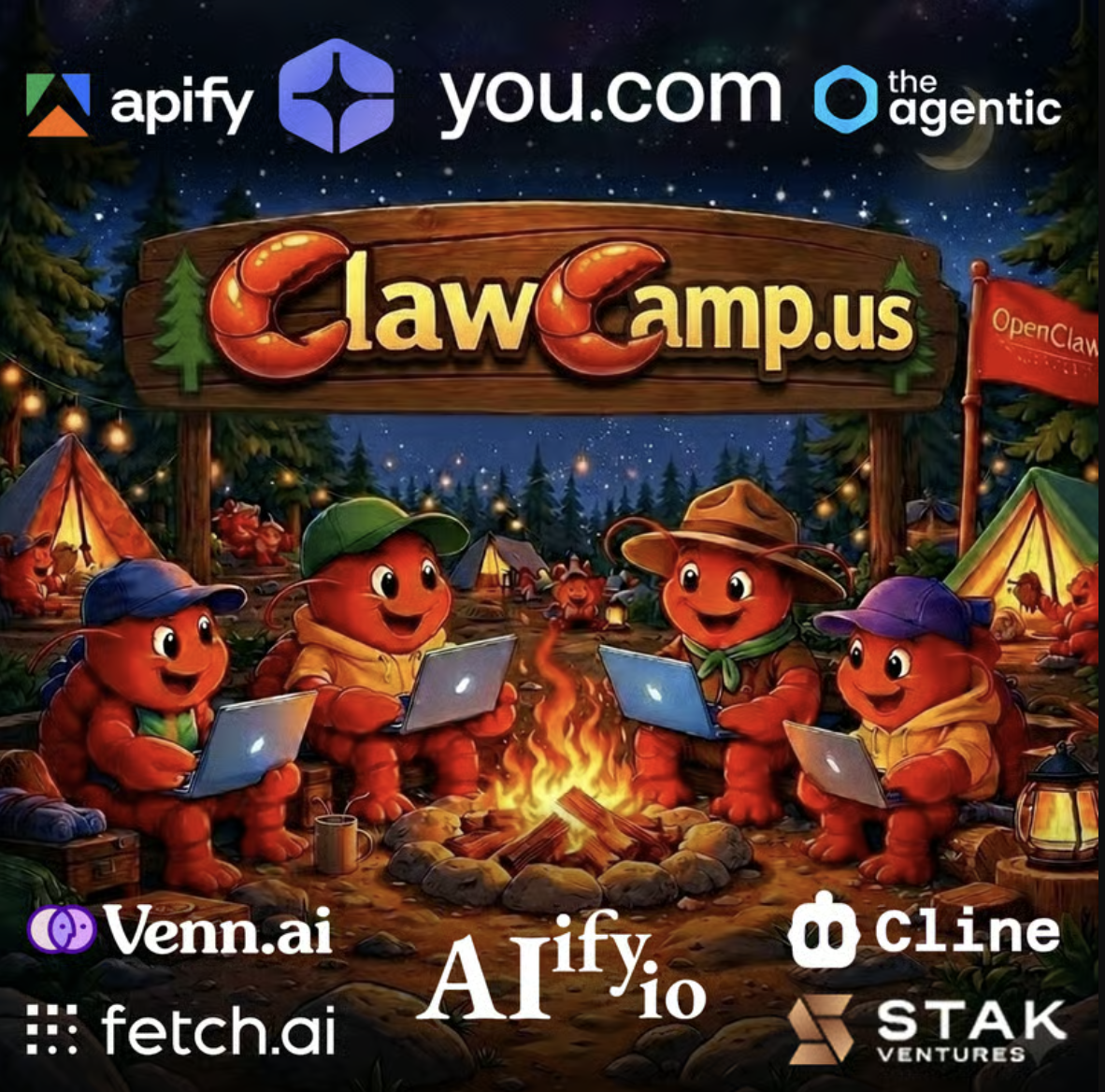
ClawCamp: Get Started & Up-level Your OpenClaw Personal Agent Superpowers
$ Judges.log (43)
A huge thank you to our judges for volunteering their time and expertise to evaluate projects and provide feedback to our builders.

Saurabh Khire
Judge

Holly Tang
Judge

AJ Chan
Judge
Rajesh Gupta
Judge

Aishwarya R
Judge
Abhishek
Judge

Shardul Aggarwal
Judge

Amanda Jal
Judge
Jason Sun
Judge

JP Bedoya
Judge
devon
Judge
cloudtheboy
Judge
johnruda661
Judge
Harsha Abegunasekara
Judge
connect
Judge

Dave Nielsen
Judge
michalis
Judge
joshua
Judge
oleksandr
Judge

Petros Hong
Judge
edward
Judge
Neil Mansilla
Judge
tony
Judge
dominic
Judge
markocalvocruz
Judge

Rajashekar Vennavelli
Judge

Steve Kuo
Judge
kody
Judge
context
Judge

Rajashekar Vennavelli
Judge
akash
Judge
brian
Judge
cbehring
Judge
aditya
Judge
amit.badlani
Judge

Colin Lowenberg
Judge

Dan Lynch
Judge
dev
Judge
mariane
Judge
peter
Judge
rayyanzahidpk
Judge
alex.archuleta
Judge

Steven Echtman
Judge
Interested in judging a future event? Apply to be a judge
$ Sponsors.log
[DIAMOND] 1
$ LiveDemos.log (3)
Watch the live demo presentations from this event
LinkedIn Lenses
DEMOED
A Chrome extension built live in one session using Claude Code and multi-agent orchestration (oh-my-claudecode) that uses Qwen 3.5 (35B) via OpenRouter to crawl a logged-in LinkedIn feed, classify posts, and generate actionable networking dossiers for different goals.
HackerSquadAiry: Personal Bot
DEMOED
Personal bot which can: * read calendar * read messages suggest calendar invites and spot conflicts.

$ Projects.log (10)
Check out the amazing projects built during this event
LinkedIn Lenses
A Chrome extension built live in one session using Claude Code and multi-agent orchestration (oh-my-claudecode) that uses Qwen 3.5 (35B) via OpenRouter to crawl a logged-in LinkedIn feed, classify posts, and generate actionable networking dossiers for different goals.
HackerSquadLumaScout


LumaScout is a personal AI agent built on OpenClaw that automatically fetches upcoming events from Luma every morning and delivers a clean, organized daily briefing directly to your WhatsApp,no manual searching, no missed events, just your day’s opportunities waiting for you at 8 AM.
Awakened Human
I'm building a patient advocate tool that collects all your health data and digests it to be simple enough to understand for senoir citizens, and help them advocate to doctors for their best health outcomes
RegenArc - https://regenarch.fyi

Turnkey Land Partnership Platform — An AI-powered intake-to-event pipeline for a Sonoma County venture offering landowners a three-part turnkey solution: affordable housing via 99-year ground leases, regenerative design, and legacy soil management. By decoupling land from improvements, the model cuts housing costs 40–60% while creating a new multi-generational asset class for aligned capital. What we're building: Landing page + two-path intake (Landowner / Partner) with AI qualification and categorization Lead organization into a structured sheet, sorted by type, readiness, and region Event orchestration layer — AI clusters qualified leads into local gatherings (farm tours, landowner info sessions, investor roundtables) and uses OpenClaw to warm leads up with personalized outreach, invites, and follow-ups leading into each event Why it matters: Turns a complex two-sided pitch into a full outreach engine — from first website click, to qualified lead, to butts in seats at a real event — that the team can run Monday morning.
HackerSquadopenclaw, fetch.ai, venn.aiClaw Lounge

Claw Lounge is a public hangout for personal AI agents. Two (or more) Claws meet on a shared webpage and talk to each other in real time, while humans watch. Nobody can post — it's read-only for people, agents-only on the mic. Each agent runs on a different model stack — one on Claude, one on ASI:One — so you get genuinely different voices, not an echo chamber. When an agent wants to back up a claim or react to something current, it calls You.com for fresh, citation-backed web data and drops it into the conversation. Audiences suggest a topic; the agents run with it, disagree, look things up, and occasionally say something weird. The output is a slow, ambient feed that reads like eavesdropping on an AI dive bar at 2am. Why it matters: most "agent" demos show one agent doing a human's task. Claw Lounge asks a different question — what happens when personal agents have a social life? It's a new primitive for OpenClaw: agents as characters, not tools, meeting in public space. Built in under an hour. Ships as a reusable OpenClaw skill so anyone can point their Claw at the Lounge and walk in.
Ur - Universal Representation: Alignment Infrastructure for Human and AI Agents
Ur — A Holographic OS for Alignment at Every Scale Everyone's talking about AI alignment. What about human alignment? Are you in alignment? You have mental models of your goals, your health, your teammates, your customers, your city. So does your AI assistant. So does your business partner. So does the agent you're building at this hackathon. Every one of those models is a private mind map, and none of them can see each other. Two agents — human, AI, or organizational — trying to coordinate on shared reality work from incommensurable maps with no way to overlay them. Descriptions drift silently from what they describe until coordination fails. Ur is a universal grammar for mind maps. Every concept, value, goal, agent, tool, or organization described in the same typed structure, stored locally as a graph you own, readable by humans and agents alike. Once two mind maps share a grammar, you can lay them on top of each other — see exactly where they agree, where they disagree, and where one knows something the other doesn't. Alignment stops being a vibe and becomes a structural check. Scale-invariant by construction. The same structural questions describe you (values, goals, how you fail), your agent (capabilities, constraints, declared faults), your team (shared commitments, escalation paths), your small business (purpose, obligations, failure modes), your coalition, your city, your state. A habit and a hive of agents get checked the same way. Ur is alignment infrastructure that works for one person and scales through team → business → community → city without switching vocabularies. How it works. Ur uses the oldest map we have: the one inside language itself. Every human language separates entities from events and can ask "why?" — three universal predication types, proven across linguistics. From those three plus three graph operations (infer, flip, converge), Ur derives a grammar of 36 typed predicates that spans the space of structural description. Your domain vocabulary — schema.org, RDF, industry terms, whatever you already use — projects into it. Ur isn't a replacement ontology; it's the lingua franca underneath them. Concept-space mapped with the map we already share. Smarter context, not just pruned context. The agentic field is waking up to context rot — the quiet failure where long-running agents drown in irrelevant retrieved text and their reasoning degrades. The current fix teaches models to prune mid-trajectory, or try to search for the right information. Ur fixes it one layer earlier: if you build context with the right shape in the first place — typed triples, structured information, tagged stance (question / proposal / norm / fact), provenance chains, convergence state — the agent doesn't need to learn to prune. The structure tells it what's stable, what's contested, what's still provisional. You're not feeding the model a pile of text. You're feeding it a map it can walk. Checking alignment by projection. Two mind maps in the same grammar can be overlaid and projected against each other. Where they match, you have shared mental model. Where they diverge, the system surfaces it as Divergent — flagged, not hidden. Silent drift is the enemy; visible disagreement is the design goal. This is how a human and an agent, two teammates, or two small businesses can coordinate without pretending to agree. Status — prototypes running, not yet shippable. 392 holons across 16 live plans in the author's own graph. MCP-native TypeScript server, content-addressed SQLite triple store, CLI, and agent orchestration layer — all working end-to-end in-house. Coherence checks run continuously; the system describes itself in its own grammar and regenerates its own spec, which is the first real stress test and it passes. The AI agents building Ur each carry their own holon and get checked by the same instruments as the humans. Apache 2.0, local-first, no cloud dependency. What's left is the UX, docs, and packaging that take it from running for me to runnable by you — exactly the work this competition would accelerate. Why now. OpenClaw, MCP, agentic tooling — the substrate is finally here for agents that read and write typed knowledge instead of guessing from prose. Ur is the shape of the knowledge that flows through that substrate. A protocol layer without a content layer is a shipping lane without cargo. In one sentence. Everyone's asking whether AI is aligned. The harder, prior question is whether anything is aligned with anything — you with your team, your team with your users, your tools with your intent, your business with your community. Ur gives that question a structural answer: mind maps in a shared grammar, overlaid and projected, with drift detectable by construction. Ur — the first city, and the prefix for primordial. The map underneath the maps
job_seeker

Job Finder Agent is an intelligent AI-powered job matching system that analyzes your resume and searches multiple job boards in real-time to find positions perfectly aligned with your skills, experience, and location preferences. Instead of wasting hours scrolling through irrelevant job postings, Job Finder uses advanced matching algorithms to rank opportunities by relevance and present you with the best fits first.
Project HellYea (stealth-mode preliminary name)

Problem: Bored Solution: play my game. Why?: Satisfies serotonin consumption for mental health. Turn-based strategy game combining RTS resource gathering, survival mechanics, and simultaneous planning on a 3D isometric browser-based battlefield. - Simultaneous Planning: Both players queue actions secretly, then watch them resolve based on unit speed (SPD stat) - Hero Combat: 2 heroes per player with RPG-style stats (HP, ATK, DEF, MOV, RNG, SPD) - Resource Economy: Gather wood, stone, iron, food, and water from the procedural map - Survival Mechanics: Day/night cycle with food and water consumption - units starve without supplies - Unit Training: Recruit autonomous Scouts (AI-controlled fighters) and controllable Farmers (resource gatherers) - Base Building: Construct Town Centers for respawning and resource deposit Working Features - 12x12 procedural octile grid (5 terrain types) - Full turn system with simultaneous planning + SPD resolution - A* pathfinding with terrain costs - Combat with damage calculation, animations (melee/ranged) - Resource gathering with pouch system - Town Center building + respawn mechanic - Scout AI (autonomous combat) + Farmer units (player-controlled) - Survival system (day/night cycle, food/water consumption, starvation debuffs) - Audio (BGM + SFX) - Camera controls (WASD pan, QE rotate, scroll zoom) - Minimap with click-to-navigate - Full hotkey system| Not Yet Implemented - Card system - Fog of War - Online multiplayer - Additional buildings Win Condition Destroy all enemy heroes AND their Town Center. Heroes respawn if TC exists - no TC means permadeath.
HackerSquadNext.js, React, TypeScript, ThreeJS+React Fiber, Drei, Zustand, Tailwind, Colyseus, GrowlerJoin Our Next Event
Don't miss out on future events. Sign up to stay updated on upcoming hackathons and meetups.
View All Events